Why Africa’s Next Port Advantage May Depend on How Intelligently It Uses Data.
Africa is investing heavily in the future of its ports.
More terminals. Deeper berths. Digital platforms. Port Community Systems.
Electronic documentation. National Single Windows. Automated cargo processes.
But as African ports become increasingly digital, another question is emerging:
What happens when ports generate more data than humans can effectively interpret?
A vessel produces information before it reaches port. Cargo generates information before it arrives at the terminal. Customs processes information before cargo is released. Terminals generate data as containers enter, move through and leave the yard. Trucks generate information as they approach the port.
Shipping lines, freight forwarders, regulators, financiers and logistics providers all hold pieces of the same commercial transaction.
The opportunity presented by artificial intelligence is therefore not simply to automate individual processes.
It is to connect information, identify relationships and turn data into intelligence.
That distinction could become increasingly important to Africa’s maritime competitiveness.
From Digital Ports to Intelligent Ports
Digitalisation has already changed the way ports operate.
Paper documents are being replaced by electronic systems. Cargo can be tracked digitally. Port users can exchange information through shared platforms. Vessel and terminal operations can be monitored electronically.
These developments matter because moves faster when processes become digital.
But digitalisation primarily improves visibility. Artificial intelligence introduces the possibility of foresight.
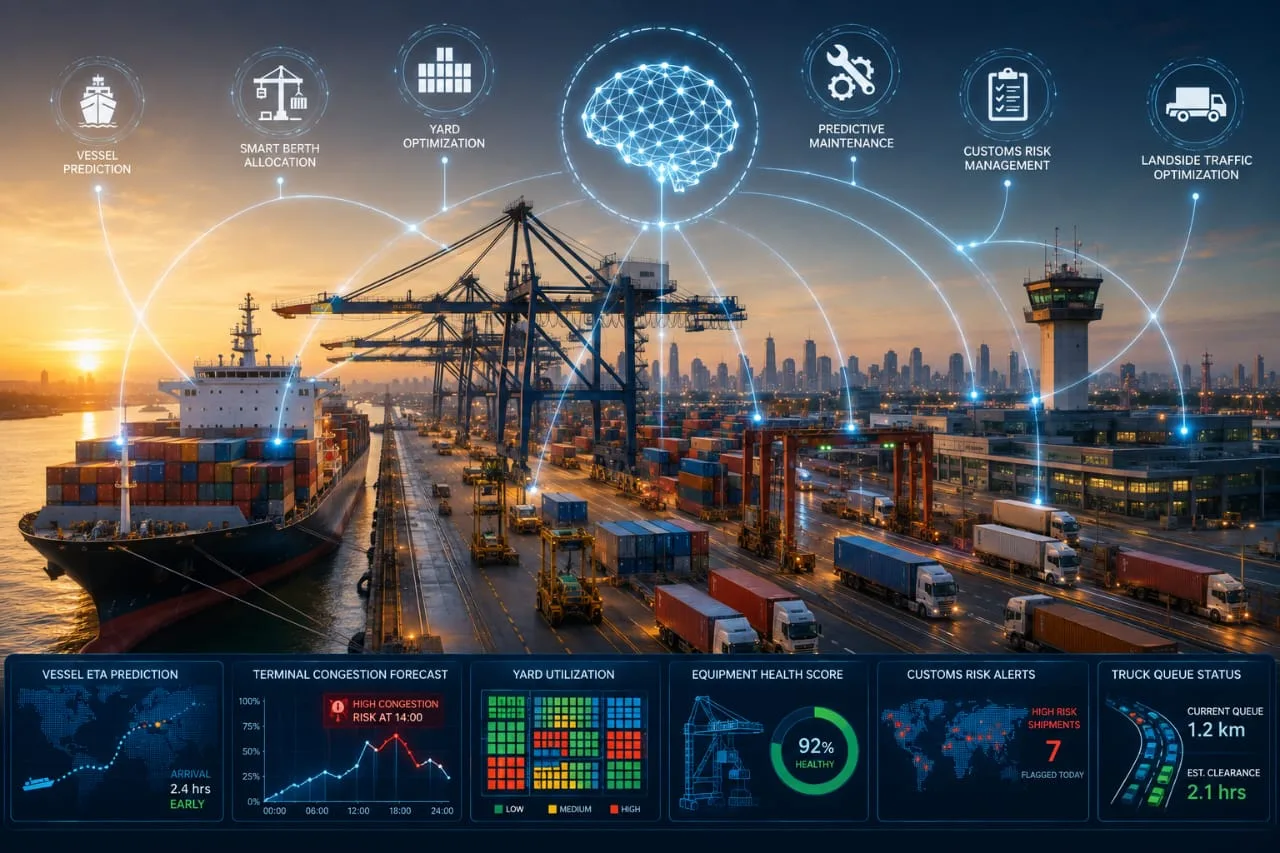
A digital system can tell a terminal that truck arrivals are increasing. An AI-enabled system could analyse truck movements, cargo readiness, terminal capacity, road conditions and vessel schedules to assess whether those conditions are likely to produce congestion several hours later.
A digital maintenance system can show that a crane is operating. A predictive system can analyse vibration, temperature and operating patterns to identify signs that the equipment may be approaching failure.
A customs platform can process thousands of declarations. AI can examine relationships across transactions and identify patterns that may warrant closer attention.
The shift is fundamental:
From recording what is happening to anticipating what may happen next.
For African ports, that could have significant economic consequences.
The Port Is Becoming a Data System
The modern port is no longer simply a physical location where ships exchange cargo.
It is an information ecosystem. A vessel’s arrival affects berth allocation. Berth availability affects terminal operations. Terminal operations affect yard capacity. Yard capacity affects truck scheduling. Truck movements affect surrounding roads. Cargo clearance affects when containers can leave. Rail and barge availability affect how cargo moves inland.
Each part of the system influences another. Yet these activities are often managed through different institutions, platforms and datasets.
That fragmentation presents one of the biggest opportunities for artificial intelligence.
AI can only be as useful as the system it can see. The more fragmented the information environment, the weaker the intelligence.
Africa’s AI challenge may therefore not begin with computing power.
It may begin with a more basic question:
Can African ports connect the data they already generate?
What Could AI Change Inside an African Port?
Vessel and Berth Management
Port efficiency begins before a vessel reaches the berth. Arrival times change. Weather conditions change. Cargo operations take longer than expected. Berths become unavailable. Another vessel arrives earlier than anticipated.
AI can potentially combine vessel-position information, historical arrival patterns, weather, berth availability and operational data to improve predictions around vessel movements and berth demand.
The objective is not simply to make vessels move faster.
It is to make port operations more predictable.
Predictability matters because uncertainty has a cost.
A vessel waiting for a berth creates costs for the shipowner. A terminal operating below capacity loses productivity. A delayed cargo creates consequences further along the supply chain.
The economic value of AI may therefore lie as much in reducing uncertainty as reducing time.
Yard Management
The container yard presents another intelligence opportunity.
A terminal knows where containers are located, when they arrived, their cargo status, expected collection dates and available capacity.
Those individual pieces of information become more powerful when analysed together. AI can potentially identify containers likely to remain longer, anticipate areas of the yard approaching capacity and determine where incoming containers should be positioned to minimise unnecessary movements.
The question changes from:
Where is the congestion?
to:
Where is congestion likely to develop?
That is a fundamentally different approach to port management.
Predictive Maintenance
Port productivity depends heavily on equipment:
cranes, gates, terminal handling equipment, power systems and other critical infrastructure. When equipment fails unexpectedly, the consequences extend beyond the machine itself. Vessel operations can be delayed. Yard movements can slow. Labour resources can be disrupted. Truck schedules can change. Cargo delivery can be affected.
Sensors and operational systems can generate continuous information about equipment performance. AI can analyse those patterns and potentially identify abnormal behaviour before failure occurs. Maintenance consequently moves from a reactive exercise towards a predictive one.
The objective is not to eliminate equipment failure completely.
It is to reduce the number of failures that arrive as surprises.
Customs and Cargo Risk
AI could also reshape customs risk management.
The opportunity goes beyond reading documents faster.
It is pattern recognition.
A system could analyse relationships among cargo descriptions, declared values, origins, importers, previous transactions, inspection results and other available information to identify anomalies. That could allow customs authorities to direct greater attention towards transactions presenting higher levels of risk rather than treating every transaction identically.
But there is an important institutional boundary.
AI should support regulatory judgement, not replace it.
The machine identifies the pattern. The authorised officer makes the decision.
That distinction becomes particularly important when algorithms begin influencing decisions with financial or regulatory consequences.
Nigeria: The Opportunity Is Bigger Than AI
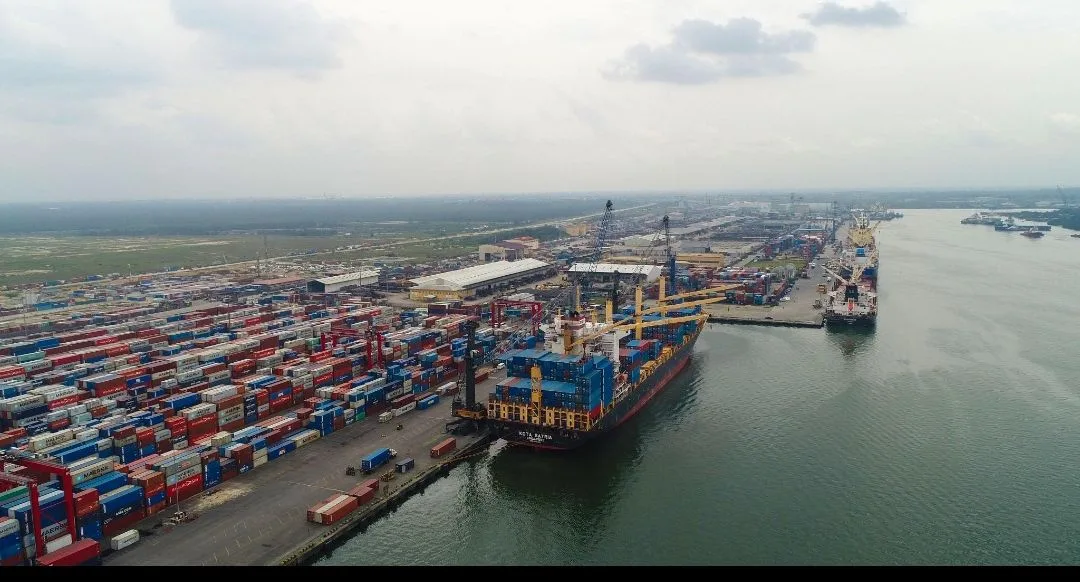
Nigeria provides one of Africa’s most important test cases.
The country is pursuing port digitalisation alongside the development of a National Single Window and other initiatives intended to improve information exchange and trade facilitation. The opportunity, however, is larger than simply putting existing processes online.
It is about connecting them. Consider the information surrounding a vessel approaching Lagos. The shipping line knows its expected arrival. The terminal knows its berth and yard conditions. Customs has cargo information. The port authority has operational information. Truck operators need to know when cargo is ready.
Road conditions around Apapa are changing. Rail and barges may provide alternative
transport capacity. Each institution possesses valuable information.
But the economic value becomes significantly greater when those signals can be understood together.
An intelligent system could potentially identify:
- when a vessel is likely to arrive late;
- when berth capacity is likely to become constrained;
- which containers may create future yard pressure;
- when truck demand may exceed terminal capacity;
- where congestion is likely to spread;
- which transactions deserve additional scrutiny;
- when critical equipment is showing signs of deterioration; and
- when alternative transport capacity should be considered.
That is a different proposition from simply digitising the port.
It is the possibility of making the port predictive.
The Apapa Question
Nigeria’s experience with port-related congestion illustrates why this distinction matters. Congestion is often addressed after it becomes visible.
The queue forms. Traffic builds. Interventions are introduced. Stakeholders respond. The system gradually returns to normal.
AI creates the possibility of moving the intervention further upstream.
What if a system could identify that a combination of vessel arrivals, cargo
releases, terminal capacity, truck availability and road conditions was likely to produce a major congestion event before the queue actually formed?
The response could begin earlier. Truck appointments could be adjusted. Cargo
movements could be prioritised. Terminal resources could be repositioned. Alternative
transport capacity could be activated. Relevant agencies could receive an early warning. The most valuable application of AI may therefore not be eliminating congestion after it appears. It may be preventing predictable congestion from becoming a crisis. That is a more useful way to measure intelligent port technology.
Lekki and the Next Generation of Nigerian Ports
Nigeria’s newer port infrastructure creates another strategic opportunity.
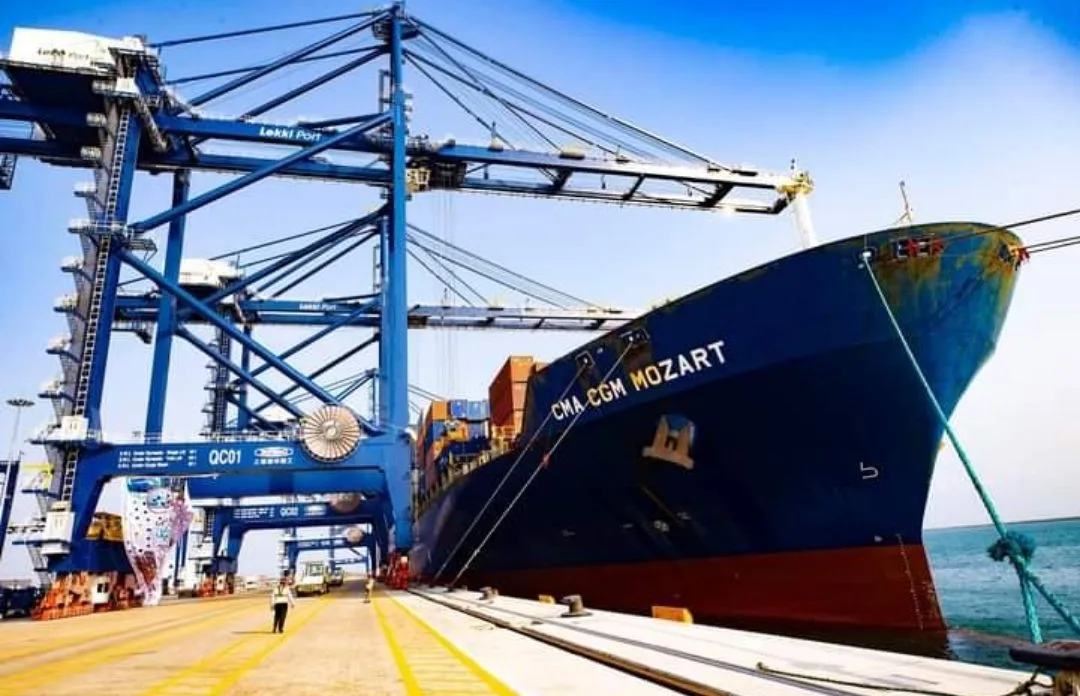
Lekki Deep Sea Port entered an operating environment very different from that of older Lagos port infrastructure.
The question is whether intelligence will simply be added to existing systems or whether interoperability, data standards, sensors and analytics will become part of port architecture from the beginning.
The difference matters. Retrofitting intelligence into fragmented systems can be difficult and expensive. Designing digital interoperability into new infrastructure creates a different possibility:
building intelligence into the port rather than adding it later.
Nigeria therefore has an opportunity to think beyond individual terminals.
Its ports can increasingly be treated as components of a wider national logistics
intelligence system connecting maritime, terminal, customs and inland transport
information. That means building not only physical infrastructure, but information infrastructure around it.
AI Cannot Fix a Broken Data System
This is where the enthusiasm around artificial intelligence requires caution.
AI is not magic. If agencies produce inconsistent data, AI inherits the inconsistency.
If systems cannot communicate, AI cannot see the complete picture. If information arrives late, predictions become weaker.
If datasets are incomplete, conclusions become less reliable. And if institutions do not share relevant information, no algorithm can manufacture information that does not exist.
Africa therefore faces a foundational question:
Are we building AI-ready ports, or simply placing AI on top of fragmented digital systems? The answer may determine whether the technology produces genuine economic value.
The New Port Competition May Be About Data For decades, port competition has largely been understood through physical infrastructure.
Depth. Berths. Cranes. Yard capacity. Roads. Rail. Location.
Those remain critical. But another form of infrastructure is becoming increasingly important:
data infrastructure.
A port that can see more of its operating environment has an advantage over one that sees isolated activities.
A port that can anticipate disruption has an advantage over one that reacts to it.
A port where information can move between agencies has an advantage over one where every institution operates its own information island.
The next generation of port competition may therefore not be determined only by physical capacity. It may increasingly depend on intelligence capacity.
Africa’s AI Question Is Also a Sovereignty Question
As ports become more dependent on digital systems, another strategic issue emerges. Who controls the infrastructure through which African trade data moves?
Who owns the data?
Where is it stored?
Who has access?
Who maintains the algorithms?
Can African authorities independently audit critical systems?
Can a port change technology providers without disrupting operations?
And what happens when cyber attacks target the systems connecting a country’s trade gateway? These are no longer purely technology questions.
They are questions of economic security.
Africa should therefore not approach port digitalisation simply as a procurement exercise. It needs stronger frameworks for data governance, cyber security, interoperability and technology accountability.
The objective should not be technological isolation. It should be technological capability and strategic control.
The Human Capability Behind Intelligent Ports
Artificial intelligence will not eliminate the need for maritime professionals.
The intelligent port will still require harbour masters, customs officers, marine engineers, terminal managers, regulators, logistics professionals, maritime lawyers and port operators. But their work will increasingly intersect with data.
The future port professional may need to understand not only maritime operations, but also the systems interpreting those operations.
That means Africa’s AI investment must be accompanied by investment in human capability. Technology without skilled people creates dependency.
Skilled people without useful technology limits productivity.
The real opportunity lies in combining both.
From Technology Procurement to Economic Performance
This may be the most important change in how African ports approach AI.
The first question should not be: Which AI platform should we buy?
It should be: Which economic problem are we trying to solve?
If the problem is congestion, measure the reduction in truck waiting time.
If the problem is equipment failure, measure the reduction in downtime.
If the problem is cargo clearance, measure the change in processing time while maintaining enforcement quality.
If the problem is yard inefficiency, measure unnecessary container movements.
If the problem is disruption, measure how much earlier the system can identify it.
AI should therefore be judged by outcomes.
Not by the sophistication of the demonstration.
Not by the number of dashboards.
Not by the number of sensors installed.
But by whether the port performs better.
The AfCFTA Opportunity
The implications extend beyond individual ports.
The African Continental Free Trade Area seeks to create a more integrated African market. But physical trade integration also requires information integration.
A container moving from an international vessel into an African market may pass through several information environments before reaching its destination:
Ship → Port → Terminal → Customs → Truck → Border → Warehouse → Market.
If each stage operates as an information island, trade remains fragmented. If those systems can communicate, Africa begins to build something more powerful:
an intelligent trade corridor. AI could eventually move beyond optimising individual ports to identifying disruptions across regional supply chains, improving coordination
between transport modes and providing greater visibility across African trade corridors.
The strategic opportunity is therefore bigger than the smart port. It is the possibility of an increasingly intelligent African trade system.
Building the Intelligence Behind Africa’s Ports
Africa does not need to deploy AI everywhere at once.
The sequence matters. It needs to:
- build reliable and standardised data foundations;
- improve interoperability between port and government systems;
- digitise critical workflows;
- connect maritime, terminal, customs and inland logistics information;
- apply AI to specific operational problems where outcomes can be measured;
- strengthen cybersecurity and data governance;
- develop African technical and maritime expertise; and
- evaluate every technology investment against measurable economic performance.
The objective is not to make African ports look technologically sophisticated.
It is to make them more predictable, transparent, efficient, resilient and competitive.
That distinction will determine whether AI becomes another technology investment or a genuine transformation of African trade infrastructure.
PRIMEAXIS INSIGHT
Artificial intelligence could become one of the most consequential technologies in the future of African ports.
But the greatest opportunity is not automation. It is intelligence.
A port that knows where its containers are is digital.
A port that can anticipate where congestion will develop is becoming intelligent.
A port that can identify equipment deterioration before failure is becoming intelligent. A port that can recognise emerging cargo-risk patterns is becoming intelligent. And a port that can connect vessel, terminal, customs, truck and inland transport information to anticipate disruption is moving towards something more important: a predictive trade gateway.
That is the direction Africa should be thinking about.
Because the competitive advantage of tomorrow’s port may not come only from deeper water, larger cranes or bigger terminals.
It may come from the ability to see the entire system and act before disruption becomes a cost.
For Nigeria, the opportunity is particularly significant.
The country’s emerging digital port architecture can provide the information foundation. The National Single Window and other digital initiatives can improve connectivity between actors in the trade chain.
But digitisation alone will not create intelligence. The real test will be whether Nigeria can turn decision making.
And that leads to the larger African opportunity. The ports that win the next phase of competition may not simply be those that move the most cargo.
They may be those that understand their cargo, anticipate their risks and coordinate their entire trade ecosystem most intelligently.
Africa has spent decades building the physical gateways through which its trade enters and leaves the world.
The next phase is to build the intelligence behind them.