
Africa is expanding its maritime economy. But when the contracts behind that economy break down, where is the dispute resolved, and where does the economic value surrounding it go?
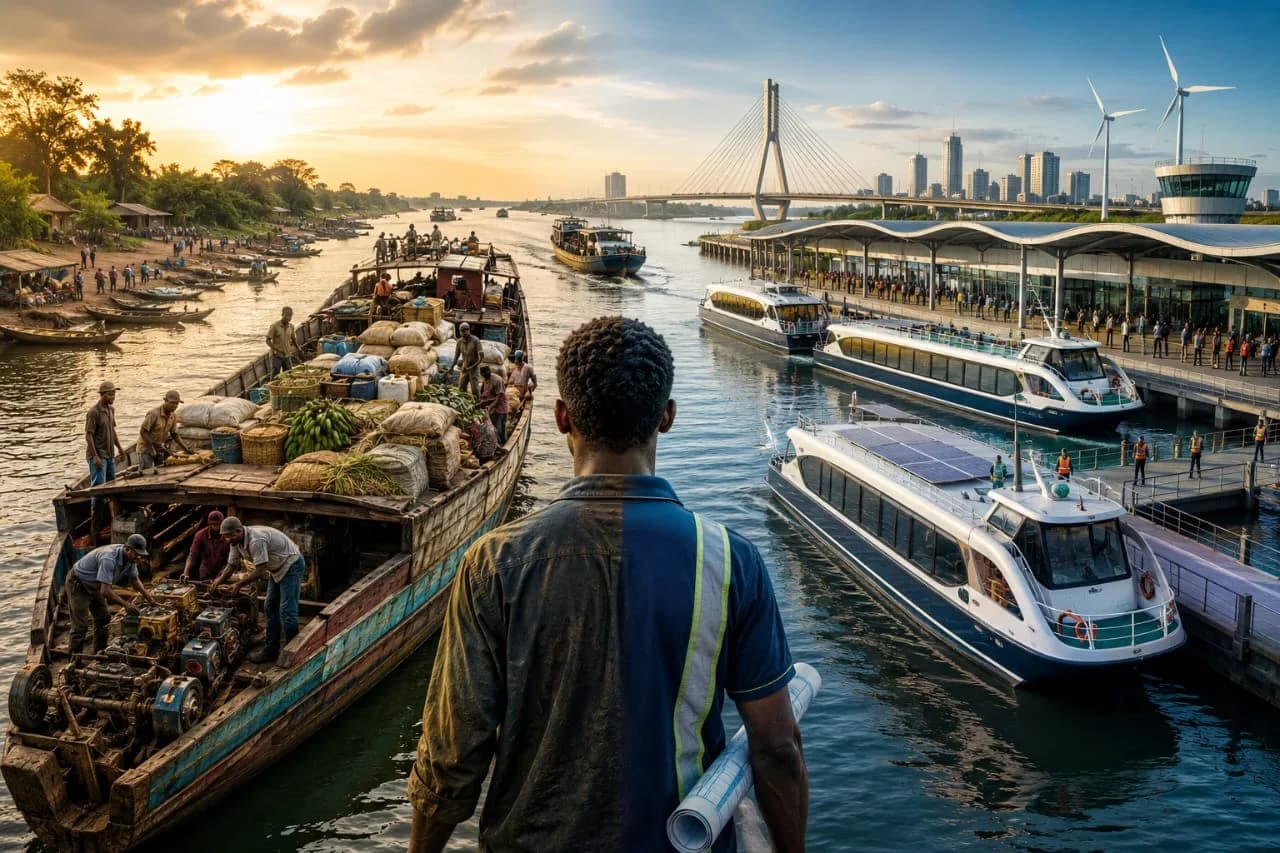
Africa wants a bigger share of the global maritime economy.
Larger ports.
More ships.
More cargo.
Shipbuilding and repair.
Offshore energy.
Maritime finance.
Intra-African trade.
Greater participation in global shipping.
But there is another layer of the maritime economy that receives considerably less attention: the business and institutional infrastructure required to resolve disputes when maritime transactions go wrong.
When a vessel is damaged, who determines liability?
When cargo is lost, who bears the cost?
When a charter party becomes contentious, where is the
dispute heard?
When a shipbuilding contract collapses, who resolves it?
When a port concession becomes disputed, which legal and institutional framework provides the forum?
And when an African company and an international shipping business disagree over a major contract, which jurisdiction offers the expertise, neutrality, procedural certainty and enforcement credibility required to resolve the dispute?
These are not peripheral legal questions.
They are questions about maritime economic power.
Africa is building maritime assets faster than it is building the professional and institutional infrastructure required to capture the full value generated around those assets.
Maritime arbitration sits squarely within that gap.
But the issue is not simply where a dispute is heard.
It is where the economic ecosystem surrounding that dispute is captured, where expertise accumulates, where professional networks are built and where the next generation of business is attracted.
That is the more consequential question.
THE DISPUTE IS PART OF THE MARITIME ECONOMY
Shipping is fundamentally contractual.
Charter parties.
Bills of lading.
Shipbuilding agreements.
Ship management contracts.
Insurance arrangements.
Port concessions.
Cargo handling agreements.
Sale and purchase contracts.
Financing arrangements.
Offshore construction contracts.
Logistics agreements.
Where there are complex commercial relationships, there will inevitably be disagreements.
That does not necessarily indicate an immature maritime economy. In many respects, it is the opposite. Sophisticated commercial activity produces sophisticated disputes.
The strategic issue is what happens when those disputes arise.
Across the world's major maritime centres, dispute resolution has evolved into an economic ecosystem of its own.
London has built deep influence around maritime law, arbitration and related professional services. Singapore has deliberately positioned itself as a major international dispute resolution hub. Other established centres have similarly combined legal expertise, institutional credibility, specialist professionals and international connectivity.
The lesson is important.
A maritime dispute is not only a liability to be resolved. It can also generate economic activity, professional expertise and institutional value.
A complex case can involve arbitrators, lawyers, marine surveyors, engineers, forensic accountants, insurers, valuation specialists, technical consultants, translators and technology providers.
It can generate expenditure on hearings, accommodation, travel, research and professional services.
It can produce knowledge, professional relationships and institutional experience.
And every successfully handled case can strengthen the reputation that attracts another.
The cycle is straightforward:
Cases create expertise.
Expertise creates reputation.
Reputation attracts cases.
Cases deepen the ecosystem.
That is how dispute resolution becomes an industry rather than merely a procedure.
Africa must therefore ask whether it is participating in this industry, or primarily generating the commercial disputes that sustain it elsewhere.
AFRICA SHOULD NOT ONLY BE WHERE THE DISPUTE ORIGINATES
Consider a major maritime contract involving an African company and an international counter party.
The underlying transaction may concern an African port, African cargo, African infrastructure or vessels operating extensively in African waters.
A dispute arises.
The arbitration clause selects a recognised foreign centre.
The arbitrators are appointed there. International counsel are engaged. Technical experts are instructed. Hearings are conducted there or through its institutional framework.
Associated court applications may follow. The award is ultimately enforced.
The underlying commercial activity may be African.
But much of the professional economic activity generated by
the dispute may occur elsewhere.
That distinction matters.
Africa can participate in maritime commerce without fully
participating in the maritime services economy surrounding that commerce.
This is the deeper form of leakage.
It is not simply about arbitration fees.
It includes professional expertise, specialist appointments, institutional learning, research, international exposure, professional relationships and reputation.
The effect compounds.
A jurisdiction that handles complex cases repeatedly develops expertise. Its professionals become more experienced. Its institutions become more credible. Its networks become deeper. Its reputation becomes stronger.
That reputation then attracts more cases.
Conversely, jurisdictions that consistently export their
high-value disputes may struggle to accumulate the very capability required to
compete for those disputes in the future.
The result is a structural disadvantage.
WHO CAPTURES THE VALUE?
This is the question Africa should place at the centre of the discussion.
When a major maritime dispute involving African commerce is
resolved outside the continent:
Who appoints the arbitrators?
Who provides the legal teams?
Who supplies the technical experts?
Who conducts the hearings?
Who provides specialist consultancy?
Who develops the research?
Who trains the professionals?
Who builds institutional experience?
And who benefits from the professional relationships created
by the case?
Often, the answer is not Africa.
That does not mean every maritime dispute should be forced into an African seat.
Nor does it mean geography should take precedence over competence.
Parties choose arbitration centres because of factors such as neutrality, expertise, procedural efficiency, confidentiality, enforceability, judicial support and trust.
That is precisely why the challenge must be approached as a question of competitiveness rather than protectionism.
If Africa wants to capture more of this economic activity, it must build institutions capable of earning the confidence of international users.
The objective is not to persuade parties to choose Africa because it is African.
The objective is to make African jurisdictions sufficiently credible that parties choose them because they are good.
THE REAL OPPORTUNITY IS BIGGER THAN ARBITRATION
A world-class maritime arbitration centre is not simply a building with hearing rooms.
It is the visible centre of a much larger ecosystem.
That ecosystem requires specialist arbitrators, maritime lawyers, marine engineers, surveyors, average adjusters and claims specialists, insurance professionals, valuers, forensic accountants, mediators, translators, digital case management systems and appropriate hearing infrastructure.
It requires academic research.
It requires professional training.
It requires international networks.
And above all, it requires confidence.
Parties must believe that the institution is independent.
They must trust the competence of its arbitrators.
They must have confidence that procedures are predictable and awards enforceable.
They must believe that the process is protected from political interference and unnecessary uncertainty.
This is why the creation of an arbitration centre, by itself, tells us very little about its competitiveness.
The institution matters. But the ecosystem around the institution matters more.
WHY TRUST MATTERS MORE THAN A BUILDING
It is relatively easy to establish an institution.
It is much harder to establish credibility.
A new arbitration centre can have modern facilities, an impressive website, international conferences and distinguished patrons.
None of these guarantees that an international party will entrust it with a dispute involving millions or billions of dollars.
Reputation is accumulated through performance.
The strongest institutions develop experienced arbitrators, reliable procedures, professional communities, judicial support and a track record of handling difficult cases.
Africa should therefore resist measuring progress primarily by the number of arbitration centres it has created.
The more meaningful question is:
How many African institutions can an international party
confidently select when the commercial stakes are exceptionally high?
That is the real test.
MARITIME ARBITRATION IS A BLUE ECONOMY INDUSTRY
Africa's blue economy conversation is still largely organised around physical activity.
Ports.
Shipping.
Fisheries.
Aquaculture.
Tourism.
Offshore energy.
Marine transport.
But mature maritime economies generate another layer of value
around those physical activities:
Legal services.
Insurance.
Finance.
Consulting.
Ship management.
Classification.
Surveying.
Engineering.
Arbitration.
Mediation.
Education.
Data and intelligence.
These services can generate substantial economic value without moving a single container.
That matters because Africa should not measure the blue economy only by the value of its physical maritime assets.
It should also measure the services ecosystem built around those assets.
A sophisticated maritime dispute resolution sector could create specialist careers, strengthen professional networks, support research and education, deepen the continent's maritime knowledge economy and position African cities as destinations for international maritime business.
That makes arbitration an economic development issue, not simply a legal sector issue.
AFRICA IS NOT JUST LOSING CASES. IT RISKS LOSING CAPABILITY.
The strategic problem is not whether an African party wins or loses a particular arbitration.
The more important question is whether Africa is building the capability to participate in the global dispute resolution economy.
Every major case handled elsewhere can represent experience that African professionals do not accumulate locally.
Every specialist appointment made elsewhere is an opportunity for local expertise that may not be developed.
Every international hearing held elsewhere strengthens another jurisdiction's institutional ecosystem.
Over time, these differences become significant.
Sophisticated industries are built through accumulated experience.
The world's leading maritime centres did not become influential overnight. Their positions were built through decades of transactions, disputes, professional networks, institutional learning and international confidence.
Africa cannot replicate that trajectory without developing a sufficient volume of credible institutional experience.
This is why the issue should be understood as one of
capability formation.
The objective is not simply to retain today's fees.
It is to build tomorrow's expertise.
THE AFRICAN QUESTION: WHERE SHOULD THE DISPUTE BE HEARD?
Africa is not a single maritime jurisdiction.
It contains different legal traditions, languages, commercial systems and levels of institutional development.
That complexity makes a single continental arbitration model neither necessary nor immediately realistic.
A more productive approach may be to develop complementary specialist capabilities across the continent.
West African jurisdictions can strengthen dispute resolution infrastructure connected to the Atlantic trade corridor.
East Africa can deepen capabilities linked to the Indian Ocean economy.
North African jurisdictions can leverage their proximity to Mediterranean shipping.
Southern Africa can build on established commercial and legal markets.
Regional economic communities can support professional networks, cooperation and cross-border capacity.
The strategic objective should not be competition for prestige among African jurisdictions.
It should be continental capability.
An African maritime transaction should, where commercially appropriate, have credible African dispute resolution options.
NIGERIA HAS A PARTICULARLY IMPORTANT ROLE TO PLAY
Nigeria's position in this conversation is difficult to ignore.
It has a large economy, a substantial coastline, major ports, significant maritime and offshore activity, extensive regional trade connections and a sizeable commercial legal profession.
It also has established arbitration experience and institutions from which a stronger maritime specialisation could be developed.
The strategic question, therefore, is not whether Nigeria has arbitration institutions.
It is whether Nigeria can become one of Africa's leading
maritime dispute resolution hubs.
That would require deliberate specialisation.
Maritime arbitration rules designed with shipping realities in mind.
A strong pool of internationally respected maritime
arbitrators.
Closer integration between legal practitioners and maritime professionals.
Specialist training.
Reliable hearing and digital infrastructure.
Strong judicial support.
Predictable enforcement.
International outreach.
And above all, a reputation for independence, competence and
procedural integrity.
Nigeria has many of the underlying ingredients.
The challenge is converting them into a proposition that
international users recognise and trust.
That proposition cannot be built on market size alone.
It must be built on performance.
THE LAWYER IS NOT ENOUGH
There is another important consideration.
Maritime disputes are rarely purely legal.
A dispute involving a vessel may require expertise in naval architecture, marine engineering, cargo surveying, port operations, insurance, accounting, chartering, environmental science, valuation, logistics or technology.
A world-class maritime dispute resolution ecosystem must
therefore be multidisciplinary.
The lawyer may understand the contract.
The engineer may understand the technical failure.
The surveyor may establish the condition of the cargo.
The insurer may understand the allocation of risk.
The forensic accountant may quantify the loss.
The port specialist may understand the operational failure.
The strongest systems connect these disciplines.
Africa already possesses much of this expertise.
What is missing is sufficient institutional connectivity between them.
That connectivity itself is an economic asset.
DISPUTE RESOLUTION IS PART OF THE INVESTMENT ENVIRONMENT
The connection between arbitration and investment is particularly important.
Investors do not assess a maritime project only on expected returns.
They also consider what happens when the project encounters friction.
Consider a port concession, ship financing transaction, offshore development or logistics infrastructure project.
An investor needs answers to basic questions:
What happens if the contract is breached?
What happens if a contractor fails?
What happens if government policy changes?
What happens if payments are disputed?
Where will the dispute be resolved?
How predictable is the process?
How independent is the forum?
How readily can an award be enforced?
These are part of the investment environment.
Strong dispute resolution infrastructure can therefore strengthen investor confidence in maritime projects.
This brings arbitration into the conversation about maritime finance.
Capital does not require only an attractive project.
It requires confidence in the mechanisms available when the project encounters disagreement.
AFRICA COULD EXPORT MARITIME LEGAL SERVICES
The ambition should extend beyond resolving disputes involving African companies.
Africa could, over time, become a destination for international maritime dispute resolution.
That requires credibility first.
But if credibility is established, the economic benefits can extend beyond arbitration fees.
International parties bring lawyers, experts, consultants and other professional services. They generate demand for accommodation, travel, research, technology and training. They create professional relationships that can extend into future transactions.
A successful maritime arbitration hub can therefore become part of a broader maritime services economy.
The model should not be copied mechanically from London, Singapore or any other established centre.
Africa's objective should be to build institutions suited to its own maritime economy, commercial realities and legal environments while meeting international standards.
THE BIGGEST MISTAKE WOULD BE TO BUILD ANOTHER INSTITUTION WITHOUT BUILDING THE ECOSYSTEM
Africa does not suffer from an absence of institutions.
Across almost every sector, there are authorities, agencies, commissions, associations and regulatory bodies.
The more difficult question is whether those institutions perform at the level required to earn confidence.
A maritime arbitration centre will not transform the sector
merely because it exists.
It needs cases.
It needs respected arbitrators.
It needs international users.
It needs enforceable awards.
It needs professional standards.
It needs research, training and data.
It needs relationships with shipping companies, insurers,
ports, maritime associations and international arbitration networks.
And it needs time.
Reputation cannot be legislated into existence. It must be earned.
This is why Africa should be cautious about creating
institutions primarily for prestige.
The continent does not need more conference rooms.
It needs institutions capable of handling difficult disputes
to international standards.
That is harder.
It is also what matters.
THINKING BEYOND ARBITRATION
The future of maritime dispute resolution will not belong to arbitration alone.
Mediation will remain important where commercial
relationships need to be preserved.
Digital dispute resolution will continue to develop.
Complex infrastructure projects increasingly require mechanisms for early intervention and dispute avoidance.
And maritime commerce itself is changing.
Decarbonisation will generate new contractual questions.
Offshore renewable energy will introduce new risks.
Digital shipping will create disputes around data, technology and cybersecurity.
Autonomous vessels could generate entirely new questions of liability.
Environmental obligations will increasingly shape commercial relationships.
The maritime dispute of tomorrow may therefore look very different from the maritime dispute of today.
Africa has an opportunity to build relevant dispute resolution capability before the next wave of maritime complexity becomes fully established elsewhere.
Waiting until those markets mature outside the continent will make the catch-up more difficult.
THE AFRICAN MARITIME ECONOMY NEEDS LEGAL INFRASTRUCTURE
Africa increasingly understands that ports require physical
infrastructure.
Roads.
Rail.
Dredging.
Cranes.
Warehouses.
Power.
Digital systems.
But sophisticated maritime economies require another layer
of infrastructure:
legal infrastructure.
Contracts must be enforceable.
Rights must be protected.
Disputes must be resolved.
Awards must be recognised.
Investors must have confidence.
Commercial relationships must be capable of surviving
disagreement.
Without that infrastructure, physical maritime assets cannot achieve their full economic potential.
This is why maritime dispute resolution deserves a more prominent place in Africa's blue economy strategy.
THE VALUE LEAKAGE AFRICA CAN NO LONGER IGNORE
When a major maritime dispute connected to Africa is resolved outside the continent, the leakage is not necessarily visible on any single balance sheet.
The arbitrators may be elsewhere.
The legal teams may be elsewhere.
The technical experts may be elsewhere.
The hearings may be elsewhere.
The associated professional spending may be elsewhere.
The research and institutional learning may accumulate elsewhere.
And the professional networks created by the case may generate the next opportunity elsewhere.
This is not an argument for forcing every dispute into an
African arbitration centre.
It is an argument for asking a harder strategic question:
Why are African jurisdictions not capturing a greater share
of the legitimate international market for maritime dispute resolution?
Established centres have an obvious advantage: history.
But history alone does not explain their position.
They became established because they accumulated competence,
consistency, institutional credibility and trust over time.
Africa can do the same.
But it must begin deliberately.
STOP EXPORTING HIGH-VALUE MARITIME SERVICES BY DEFAULT
African economies have long confronted a familiar structural
pattern.
Raw materials are exported.
Higher-value processing takes place elsewhere.
Technology is imported.
Capital is frequently sourced elsewhere.
Specialist expertise is often brought in from outside the
continent.
The same pattern can emerge in professional services
surrounding African commerce.
Maritime arbitration offers one opportunity to alter part of that equation.
Africa should not attempt to localise every international service, nor should location ever become more important than competence.
But where the continent has the human capital, commercial
demand and institutional foundations to compete, it should compete.
Dispute resolution is one such field.
The objective is not to keep value in Africa simply because
it is African.
The objective is to build institutions sufficiently good that global businesses choose Africa because they trust them.
That is the more credible proposition.
THE ENFORCEMENT QUESTION
There is one issue that cannot be avoided.
An arbitration award is only as valuable as the legal system's ability to recognise and enforce it.
Africa's ambition in international arbitration must
therefore be considered alongside the broader framework governing arbitration
agreements, judicial support and enforcement.
Courts matter.
Consistency matters.
Predictability matters.
Respect for arbitration agreements matters.
The relationship between courts and arbitral institutions matters.
A jurisdiction can have excellent arbitrators and sophisticated rules and still struggle to become a preferred seat if parties remain uncertain about the wider enforcement environment.
The objective must therefore be a complete system.
Arbitration does not operate outside the judiciary. It forms part of the same dispute resolution architecture.
THE NEXT GENERATION COULD CHANGE THE EQUATION
Perhaps the most durable opportunity is human capital.
Africa has universities, professional institutions, maritime academies, lawyers, engineers, accountants, surveyors, shipping professionals, researchers and technology specialists.
The opportunity is to deliberately develop professionals who understand both maritime commerce and international dispute resolution.
A lawyer who understands charter parties, marine insurance, port operations, arbitration procedure and international trade law is more than a legal practitioner.
That person is part of maritime economic infrastructure.
The same is true of the engineer who understands arbitration, the surveyor who understands evidence, the economist who understands damages and the maritime professional who becomes an arbitrator.
This is how ecosystems are built.
And this is how Africa can move from consuming specialist maritime services to exporting them.
THE PRIMEAXIS INSIGHT
Africa's maritime ambition has largely focused on what
happens on the water.
Ships.
Ports.
Cargo.
Trade.
Energy.
Fisheries.
But maritime power extends beyond the water.
It includes the institutions that finance maritime assets.
The systems that insure them.
The professionals who advise them.
The infrastructure that regulates them.
And, when commercial relationships break down:
the institutions that resolve the dispute.
That is where the strategic opportunity lies.
Africa does not need another arbitration centre simply because other regions have them.
It needs world-class dispute resolution capability that international businesses trust when the stakes are highest.
That requires credible rules.
Specialist African expertise.
Multidisciplinary professional networks.
Strong judicial support.
Predictable enforcement.
Professional and academic development.
International connectivity.
And, ultimately, a track record of successfully handling
complex disputes.
Because the real question is not:
Does Africa have arbitration centres?
It does.
The real question is:
Can Africa build maritime dispute resolution institutions that the world trusts when the stakes are highest?
If it can, the prize extends far beyond resolving disputes.
It is about capturing professional value.
Building institutional knowledge.
Creating specialist industries.
Developing human capital.
Strengthening investor confidence.
And positioning African cities as serious centres of
international maritime commerce.
Africa has spent decades asking how to move more cargo, attract more ships and build bigger ports.
It should now ask another question:
Who will capture the economic value when the contracts behind that commerce go wrong?
That is not simply a legal question.
It is a question of maritime power.